Silver Price in AUD
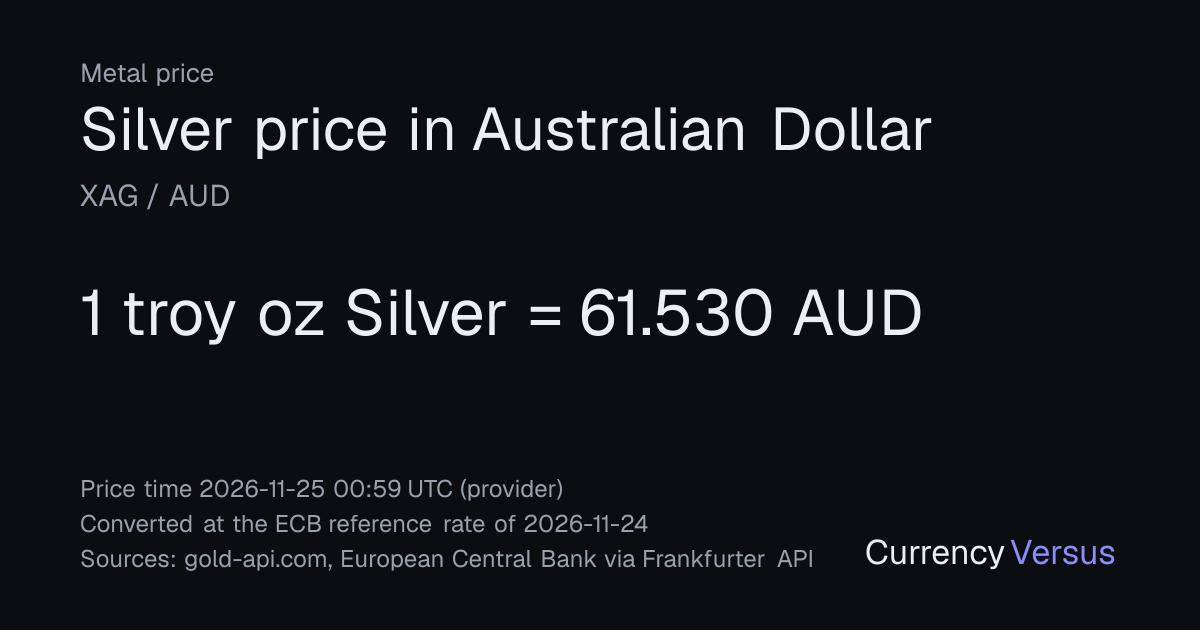
1 oz Silver = 61.530 AUD · 1 g Silver = 1.9783 AUD
Provider's last update: 2026-11-25 00:59 UTC · Source: gold-api.com (time reported by the provider; it may be when the provider last checked the price, not the last market trade)
USD→AUD conversion: ECB reference rate of 2026-11-24
Silver to AUD by weight
1 troy ounce of silver = 61.530 AUD
Troy ounce (31.1035 g) — the standard unit for precious metals, not the 28.35 g ounce used for food.
Spot value of the pure metal. A jeweller's or dealer's buying and selling prices are different.
Quick Stats
Silver to AUD — Common Amounts
| Amount | Value (AUD) |
|---|---|
| 1 g Silver | 1.9783 AUD |
| 5 g Silver | 9.8913 AUD |
| 10 g Silver | 19.783 AUD |
| 20 g Silver | 39.565 AUD |
| 50 g Silver | 98.913 AUD |
| 100 g Silver | 197.83 AUD |
| 1 oz Silver | 61.530 AUD |
| 5 oz Silver | 307.65 AUD |
| 10 oz Silver | 615.30 AUD |
About Silver as an Asset
Silver bridges the worlds of precious metals and industrial commodities. While it shares gold's monetary heritage as a store of value and safe haven, a large share of silver demand comes from industrial applications — solar panels, electronics, electric vehicles, medical devices, and more. Because a large part of its demand comes from industry, silver's price responds to manufacturing activity and the pace of the energy transition as well as to investment demand.
💡 Silver has the highest electrical conductivity of any metal, which is why it remains in use in solar cells, EV components, electrical contacts and telecommunications equipment.
What Drives Silver Prices
- Solar panel manufacturing — silver paste is used in photovoltaic cells, so growth in solar capacity adds to demand
- Industrial production cycles — much of silver demand comes from manufacturing, so the price also reacts to factory activity, not only to investment demand
- Gold prices — silver often moves with gold, but with larger swings in both directions
- US Dollar strength and real interest rates — same inverse relationship as gold
- Mining supply — much of the world's silver is produced as a by-product of copper, lead, and zinc mining, so supply responds slowly to silver prices
- EV and electronics manufacturing — silver's conductivity makes it hard to replace in many applications
Editorial content last reviewed: 2026-10-22
Silver & AUD — Local Context
Australia produces silver mainly as a by-product of lead and zinc mining; the Broken Hill region in New South Wales is historically one of the country's best-known silver districts.