Exchange rate
Indian Rupee to Euro
INR / EUR
1.00 INR =
0.01 EUR
1 INR = 0.009817 EUR · 1 EUR = 101.87 INR
ECB24 Nov 2026Where this comes fromHide details
Rates are the European Central Bank's daily euro foreign exchange reference rates, served by the Frankfurter API. The ECB publishes them on business days at around 16:00 CET; they are not live market prices and do not change at weekends or on holidays.
The figures are mid-market values: bank margins, transfer fees and card fees are not included, so the rate you are offered will differ.
Rate date: 2026-11-24 · Last checked: 2026-11-25 00:59 UTC (when this page was built)
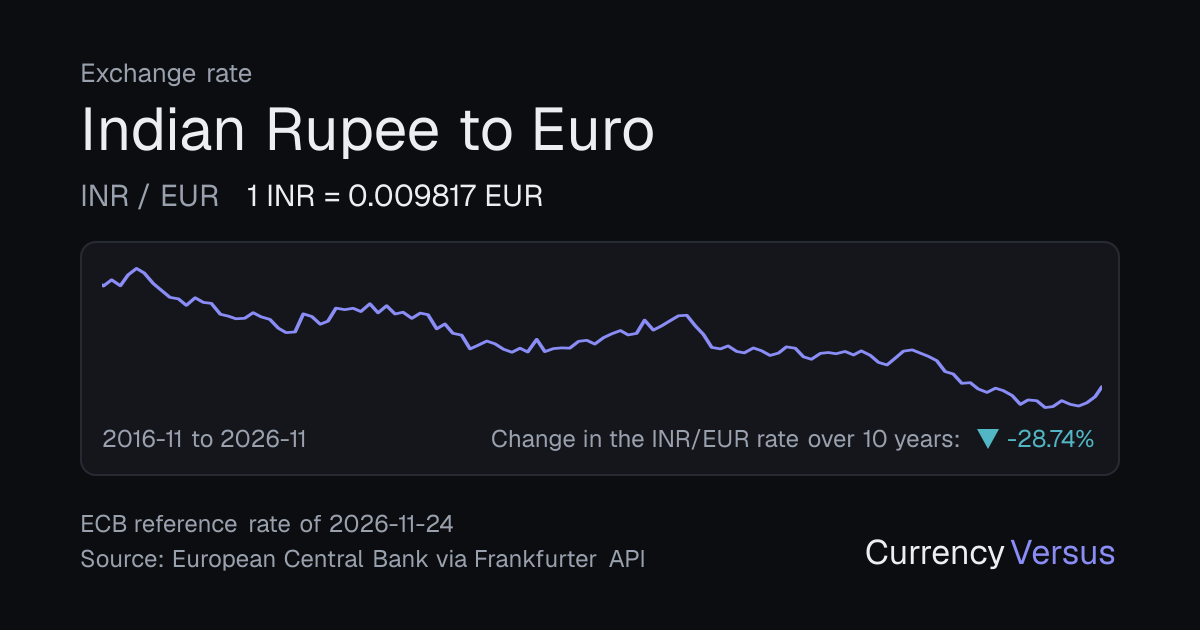
INR to EUR over time
Change
-28.74%down
0.01378 → 0.009817
Low
0.008903
2026-05-20
High
0.01464
2017-04-10
The line uses 122 monthly observations. Low and high are the extreme daily reference rates in the period, not intraday levels.
Same amount, two dates
Today: the latest ECB reference rate.
On 2016-11-25
1.38 EUR
Today (ECB 2026-11-24)
0.98 EUR
100 INR was worth 1.38 EUR on 2016-11-25 and 0.98 EUR on 2026-11-24 (ECB reference rates).
This compares exchange rates on two dates. It is not an investment return: it does not account for inflation, interest earned, or any fee.
INR/EUR compared with earlier dates
Now: 1 INR = 0.009817 EUR (ECB reference rate of 2026-11-24)
| Period | Then | Used day | Change |
|---|---|---|---|
| 1 Month | 0.009410 | 2026-10-23for 2026-10-25 | +4.32%up |
| 3 Months | 0.008987 | 2026-08-25 | +9.24%up |
| 6 Months | 0.009018 | 2026-05-25 | +8.85%up |
| 1 Year | 0.009706 | 2025-11-25 | +1.15%up |
| 3 Years | 0.01098 | 2023-11-24for 2023-11-25 | -10.63%down |
| 5 Years | 0.01196 | 2021-11-25 | -17.92%down |
| 10 Years | 0.01378 | 2016-11-25 | -28.74%down |
A rising number means one Indian rupee buys more euros — good for someone holding Indian rupees, not for someone earning euros.
Then is the daily ECB reference rate on the last business day on or before the start of the period (not an intraday level); “for” shows the date that was asked for when it fell on a weekend or holiday.
About INR and EUR
Indian Rupee (INR)
The Indian Rupee is the official currency of India and is managed by the Reserve Bank of India. Its exchange rate reflects India's large economy, its dependence on energy imports, and foreign investment flows.
India's economy is driven by IT services, pharmaceuticals, textiles, and a very large domestic consumer market.
What moves it
- Reserve Bank of India interest rate and inflation targeting
- Crude oil prices (India is a major oil importer)
- Foreign direct investment and IT sector performance
- Indian monsoon season and agricultural output
Euro (EUR)
The Euro is the official currency of the euro area (Eurozone), shared by many European Union member states. It is one of the world's major trading and reserve currencies.
The euro area is one of the world's major economic blocs, anchored by economies such as Germany and France. The European Central Bank (ECB) sets a single monetary policy for all euro area members.
What moves it
- ECB monetary policy and interest rates
- Economic performance of major Eurozone economies
- Political stability within the EU
- Eurozone inflation and employment data
Did you know? — INR
The Indian rupee symbol ₹ was officially adopted in 2010, designed by D. Udaya Kumar, combining the Devanagari letter 'Ra' and the Latin letter 'R'.
Did you know? — EUR
The Euro was introduced as an accounting currency in 1999 and physical euro coins and banknotes entered circulation in 2002.
Frequently Asked Questions
How much is 1 INR in EUR?
Based on the European Central Bank reference rate published on 2026-11-24, 1 INR equals 0.0098 EUR. This is a mid-market reference rate; bank buy/sell spreads and fees are not included.
What is the INR to EUR exchange rate today?
The latest published ECB reference rate (2026-11-24) is 0.0098 EUR per 1 INR. The ECB publishes once per business day around 16:00 CET, so the rate does not change over weekends or holidays.
Where does CurrencyVersus get its INR/EUR data?
CurrencyVersus sources all exchange rate data from the Frankfurter API, which provides European Central Bank (ECB) reference rates. The ECB publishes these once per business day, around 16:00 CET; they are not live market quotes. Gold, silver, platinum and palladium prices come separately from gold-api.com and update more often than the daily ECB reference rates.
Can I view historical INR to EUR exchange rates?
Yes. CurrencyVersus provides historical INR/EUR exchange rate data across 7 time periods: 1 month, 3 months, 6 months, 1 year, 3 years, 5 years, and 10 years.
Editorial content last reviewed: 2026-10-22