Exchange rate
Swiss Franc to Canadian Dollar
CHF / CAD
1.00 CHF =
1.71 CAD
1 CHF = 1.710 CAD · 1 CAD = 0.5846 CHF
ECB24 Nov 2026Where this comes fromHide details
Rates are the European Central Bank's daily euro foreign exchange reference rates, served by the Frankfurter API. The ECB publishes them on business days at around 16:00 CET; they are not live market prices and do not change at weekends or on holidays.
The figures are mid-market values: bank margins, transfer fees and card fees are not included, so the rate you are offered will differ.
Rate date: 2026-11-24 · Last checked: 2026-11-25 00:59 UTC (when this page was built)
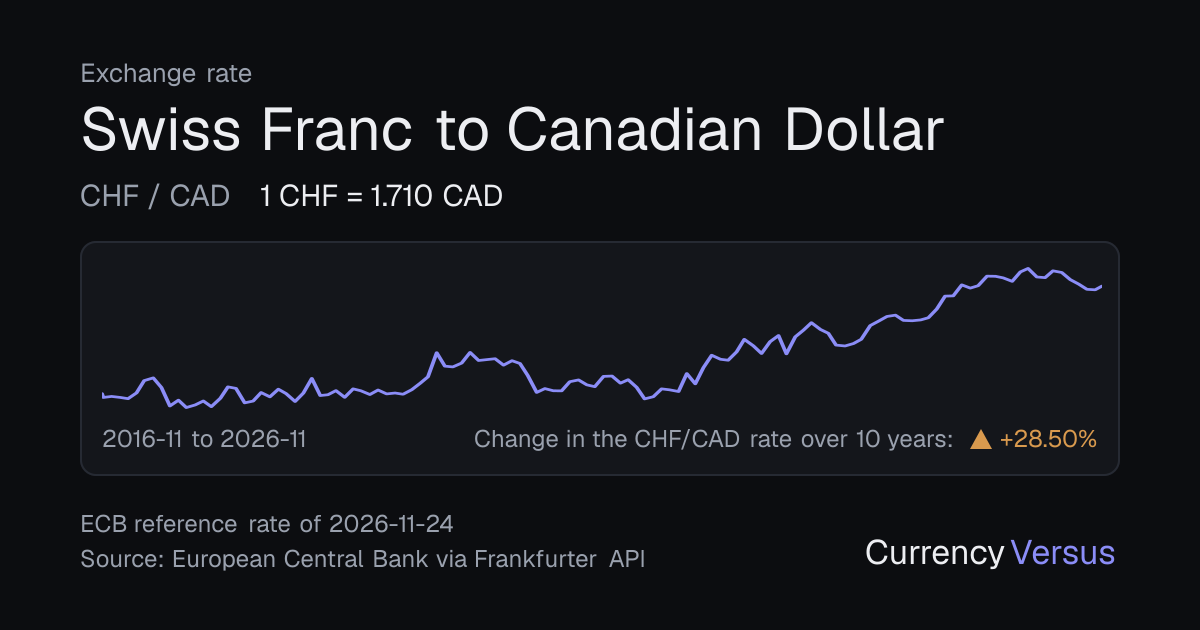
CHF to CAD over time
Change
+28.50%up
1.331 → 1.710
Low
1.261
2017-09-14
High
1.778
2025-11-14
The line uses 122 monthly observations. Low and high are the extreme daily reference rates in the period, not intraday levels.
Same amount, two dates
Today: the latest ECB reference rate.
On 2016-11-25
133.10 CAD
Today (ECB 2026-11-24)
171.04 CAD
100 CHF was worth 133.10 CAD on 2016-11-25 and 171.04 CAD on 2026-11-24 (ECB reference rates).
This compares exchange rates on two dates. It is not an investment return: it does not account for inflation, interest earned, or any fee.
CHF/CAD compared with earlier dates
Now: 1 CHF = 1.710 CAD (ECB reference rate of 2026-11-24)
| Period | Then | Used day | Change |
|---|---|---|---|
| 1 Month | 1.698 | 2026-10-23for 2026-10-25 | +0.75%up |
| 3 Months | 1.727 | 2026-08-25 | -0.94%down |
| 6 Months | 1.767 | 2026-05-25 | -3.23%down |
| 1 Year | 1.744 | 2025-11-25 | -1.94%down |
| 3 Years | 1.549 | 2023-11-24for 2023-11-25 | +10.40%up |
| 5 Years | 1.357 | 2021-11-25 | +26.03%up |
| 10 Years | 1.331 | 2016-11-25 | +28.50%up |
A rising number means one Swiss franc buys more Canadian dollars — good for someone holding Swiss francs, not for someone earning Canadian dollars.
Then is the daily ECB reference rate on the last business day on or before the start of the period (not an intraday level); “for” shows the date that was asked for when it fell on a weekend or holiday.
About CHF and CAD
Swiss Franc (CHF)
The Swiss Franc is the official currency of Switzerland and Liechtenstein. It has a long reputation for stability and is widely treated as a safe-haven asset during financial turmoil.
Switzerland has a highly developed and stable economy, known for its banking sector, pharmaceuticals, and precision manufacturing. The Swiss National Bank (SNB) sets monetary policy and has at times intervened in currency markets to influence the franc's value.
What moves it
- Swiss National Bank interventions and interest rates
- Global geopolitical uncertainty and safe-haven demand
- Swiss economic indicators and trade data
- EUR/CHF dynamics and European economic health
Canadian Dollar (CAD)
The Canadian Dollar, often called the 'Loonie' after the loon bird on the one-dollar coin, is one of the reserve currencies held by central banks around the world. It is closely tied to commodity prices, especially oil.
Canada has a resource-rich economy with significant exports of crude oil, natural gas, and minerals. The Bank of Canada sets monetary policy independently from the US despite close economic ties.
What moves it
- Crude oil and commodity prices
- Bank of Canada interest rate decisions
- US–Canada trade relations
- Canadian housing market and employment data
Did you know? — CHF
Switzerland's banking secrecy laws, established in 1934, helped make the Swiss franc synonymous with financial stability and privacy.
Frequently Asked Questions
How much is 1 CHF in CAD?
Based on the European Central Bank reference rate published on 2026-11-24, 1 CHF equals 1.710 CAD. This is a mid-market reference rate; bank buy/sell spreads and fees are not included.
What is the CHF to CAD exchange rate today?
The latest published ECB reference rate (2026-11-24) is 1.710 CAD per 1 CHF. The ECB publishes once per business day around 16:00 CET, so the rate does not change over weekends or holidays.
Where does CurrencyVersus get its CHF/CAD data?
CurrencyVersus sources all exchange rate data from the Frankfurter API, which provides European Central Bank (ECB) reference rates. The ECB publishes these once per business day, around 16:00 CET; they are not live market quotes. Gold, silver, platinum and palladium prices come separately from gold-api.com and update more often than the daily ECB reference rates.
Can I view historical CHF to CAD exchange rates?
Yes. CurrencyVersus provides historical CHF/CAD exchange rate data across 7 time periods: 1 month, 3 months, 6 months, 1 year, 3 years, 5 years, and 10 years.
Editorial content last reviewed: 2026-10-22